


Quick Answer
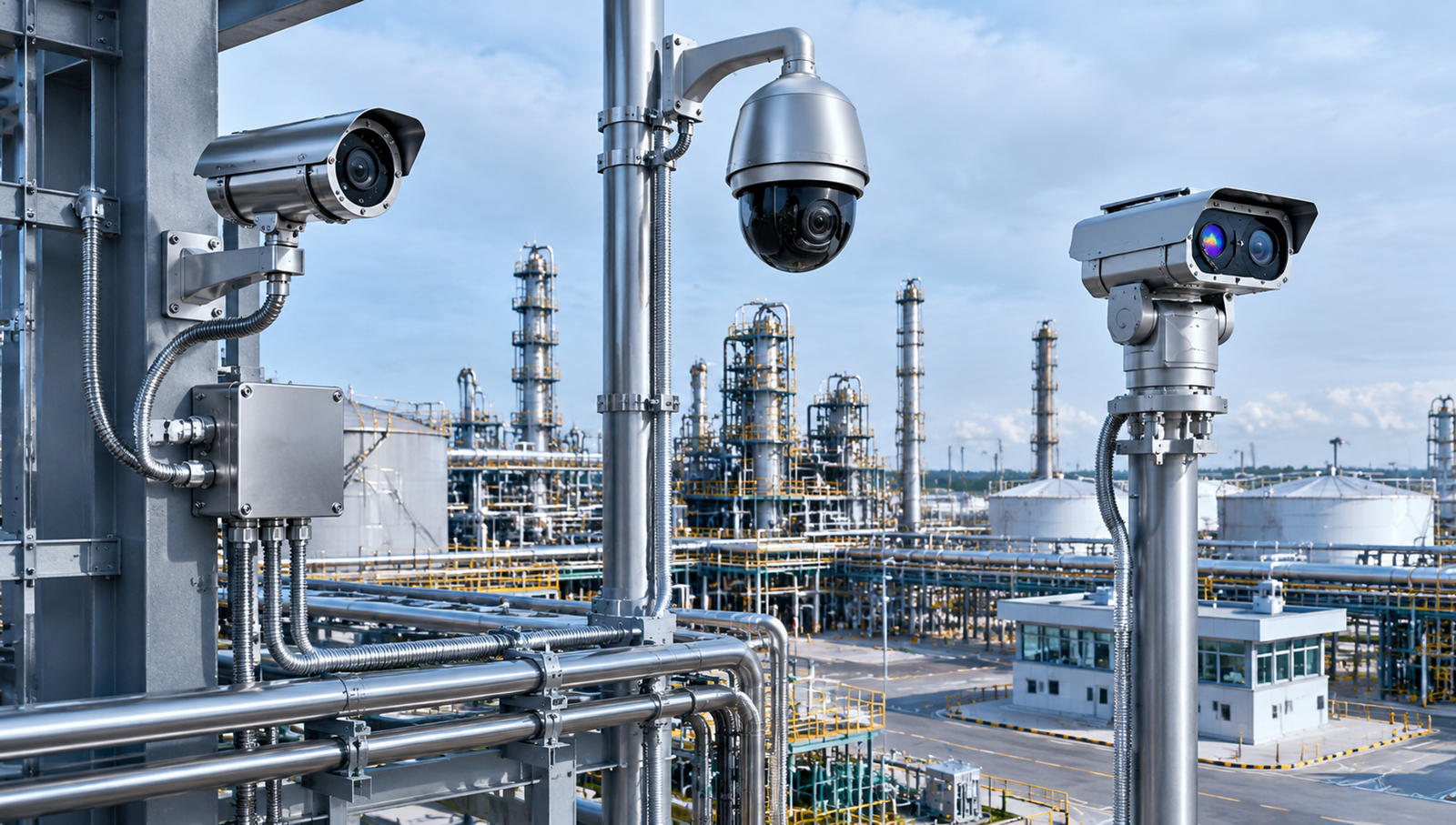
A tri-spectrum thermal PTZ combines long-range visible-light video, thermal imaging and infrared-assisted night observation in one remotely steerable platform. For industrial sites, that combination helps operators move from broad-area awareness to closer visual review of equipment, vehicles, people and changing heat patterns without relying on a single image type.
SWGJ’s Z650 Long-Range Dual-Payload/Tri-Spectrum Optical Turret is presented on the company’s product page for high-altitude and ultra-long-range observation. The published overview describes a fog-penetrating visible camera, continuous-zoom thermal imaging and a synchronized laser illuminator. It states visible observation of 5–10 km under good visibility and nighttime thermal observation of 3–5 km for people, vehicles and remote facilities. Those figures are application guidance from the product page, not a guarantee for every site, target or weather condition.
The practical value is not that one channel replaces every inspection method. Visible video provides context and detail; thermal imaging reveals differences in radiated heat; infrared illumination supports low-light viewing. Together, they give a control-room team more ways to examine an event and decide whether a closer inspection or another instrument is needed. A thermal camera should not automatically be described as a universal gas detector. Gas-specific detection requires equipment and validation intended for that purpose.
What Tri-Spectrum Means in an Industrial Camera
The word “tri-spectrum” can be confusing because product designs vary. On the SWGJ Z650 page, the published system combines three observation resources:
- Visible light: The specification table lists a 1/2.8-inch Sony IMX327 low-illumination CMOS sensor, 1080P output at 25/30 fps and a 33x optical zoom with a 4.7–141 mm focal-length range. This channel supplies recognizable visual context in daylight and low-light conditions.
- Thermal imaging: The page lists an uncooled vanadium oxide detector, 640 × 512 or 384 × 288 resolution, an 8–14 μm response band and 50 fps operation. Thermal palettes include black heat, white heat, red heat and mix. These views can make heat patterns easier to compare across machinery or process areas.
- Infrared-assisted observation: The product page lists two high-power IR lamps, with an infrared range of up to 120 m, and PWM dimming. Its overview also describes a synchronized laser illuminator for the long-range night-vision configuration. The exact illumination result depends on the selected configuration, target reflectivity and atmosphere.
These channels are complementary rather than interchangeable. A visible image may show a valve position, label or vehicle shape. A thermal image may show a developing hot area or a contrast change that deserves attention. Infrared illumination can support monochrome observation when ordinary light is insufficient. An operator can then compare the channels before escalating an issue.
This is especially useful where a large industrial site contains distant assets and changing conditions. The goal is not to claim that every thermal contrast is a fault. Instead, a thermal PTZ creates a repeatable remote observation point for identifying changes, confirming what is visible and directing qualified personnel toward the right follow-up inspection.
Why Long-Range Thermal PTZ Supports Equipment Observation
Industrial monitoring often involves more than perimeter awareness. Operators may need to observe process units, tanks, pipelines, wellhead areas, flare-stack surroundings or remote access roads from a control location. A fixed view can leave blind areas, while a short-range camera may require many units to cover a wide site. A PTZ platform offers a way to move between predefined views and inspect a selected area in more detail.
The Z650 page lists 360° continuous pan, a tilt range of -30° to 90°, 200 presets and four patrols. These functions can support a structured observation routine: patrol wide areas, call a preset for a known asset, compare visible and thermal views, and return to a standard field of view. The page also lists line scan and park functions, which can help organise repeated coverage when the system is integrated into an operator’s monitoring workflow.
Thermal imaging adds a different signal to that workflow. Heat patterns can be useful when comparing similar equipment or reviewing an area at night, in smoke or in changing visible-light conditions. The Z650 product page says the thermal channel can highlight thermal anomalies and track targets through smoke, smog or total darkness. That statement should be treated as an observation capability, not a promise of automatic diagnosis. Temperature, emissivity, distance, atmospheric effects and the asset’s normal operating state all influence interpretation.
The visible channel remains important for verification. It can help a team understand whether a thermal pattern corresponds to a pipe section, motor housing, vehicle, person or background object. This is why multi-channel observation is often more useful than treating thermal video as a standalone alarm source.
Z650 Published Capabilities at a Glance
The following summary uses details explicitly published on SWGJ’s Tri-Spectrum Thermal PTZ product page. Configurations, site conditions and final performance should be confirmed with SWGJ before procurement.
| Area | Published Z650 information | Industrial monitoring relevance |
|---|---|---|
| Visible sensor | 1/2.8-inch Sony IMX327 CMOS; 1080P at 25/30 fps | Context and visual confirmation |
| Visible zoom | 33x optical zoom, 4.7–141 mm; 30x digital zoom | Remote review of selected views |
| Thermal detector | Uncooled vanadium oxide; 640 × 512 or 384 × 288 | Heat-pattern observation in low light |
| Thermal response | 8–14 μm; 50 fps | Smooth thermal viewing and comparison |
| Thermal processing | DDE, AGC and digital filter noise reduction | Helps present thermal detail to operators |
| Thermal palettes | Black heat, white heat, red heat and mix | Different ways to display heat contrast |
| Pan and tilt | 360° continuous pan; -30° to 90° tilt | Wide-area and elevated-view coverage |
| Movement | 100°/s pan control; 60°/s tilt control | Rapid repositioning between views |
| Presets and patrols | 200 presets; four patrols; line scan; park | Repeatable observation routines |
| Environmental protection | IP67; -30°C to 60°C; 0–95% humidity, no condensation | Site suitability review for weather exposure |
| Network and video | ONVIF supported; H.264/H.265; dual stream | Integration planning with compatible systems |
| Published observation guidance | Visible 5–10 km in good visibility; thermal 3–5 km for listed night targets | Initial line-of-sight and coverage discussion |
One detail deserves special attention during technical review: the Z650 page describes a tri-spectrum optical turret and lists an “Explosion-Proof Structure Design,” but the page does not provide a complete certification schedule for the exact configuration in the parameter table. SWGJ’s oil and gas and petrochemical pages discuss ATEX-certified explosion-proof solutions generally. Buyers working in a classified area should request the applicable certificate, protection concept and configuration-specific documentation rather than infer certification from the product category alone.
Thermal Imaging for Oil, Gas and Petrochemical Observation
SWGJ identifies oil and gas exploration and the petrochemical industry as industrial application areas. The company describes exploration sites as demanding environments where operators monitor drilling floors, wellheads and mud pits. For petrochemical facilities, its page refers to distillation columns, storage tanks and pipeline networks as areas requiring continuous high-definition surveillance.
A tri-spectrum PTZ can support these use cases by giving operators a long-range visual and thermal viewpoint. In daylight, visible zoom can help review the position and condition of a remote asset. At night, thermal imagery can support observation when scene lighting is poor. Infrared-assisted video can add another low-light view within the published illumination range. PTZ movement can then shift attention among process areas or remote approaches.
The important boundary is what the camera does not establish by itself. General thermal imaging shows radiated heat patterns; it is not automatically optical gas imaging, a calibrated gas analyser or a universal gas-leak detector. A heat contrast near a pipeline, pump or vessel may have many possible causes, including normal operation, reflection, insulation differences or airflow. It should be reviewed against operating history and confirmed with the appropriate inspection or gas-detection method when required.
For that reason, a responsible monitoring plan defines what the camera is expected to observe: visual access, abnormal heat-pattern review, activity awareness, remote asset verification or event documentation. It also defines who investigates an alert, what normal conditions look like and which independent instruments or procedures are used for confirmation.
Building a Useful Industrial Monitoring Workflow
A long-range PTZ delivers the most value when its images become part of a repeatable workflow rather than an isolated live feed. Start by listing the assets and zones that need observation. Group them by viewing distance, lighting, expected heat behaviour and operational importance. This helps determine where visible detail matters most and where thermal comparison may add useful context.
Next, establish reference views. Presets can represent normal views of a pump area, tank perimeter, remote pipe corridor or access route. Patrols can rotate through those views at agreed intervals, while an operator can take control when a visible or thermal change deserves closer attention. Store observations with time and asset context so that later reviews compare like with like.
Image interpretation should remain disciplined. A thermal palette changes how contrast is displayed; it does not by itself prove a temperature threshold or fault condition. The Z650 page lists digital processing functions such as DDE, AGC and noise reduction, which help present imagery but should not be confused with a complete asset-health model. If a site requires quantitative temperature limits, confirm that the proposed configuration and software provide the needed measurement capability before specifying it.
Environmental review is equally important. SWGJ lists IP67 protection and an operating range of -30°C to 60°C for the Z650. The product overview also discusses fog penetration, heat-haze reduction and a wind-resistant structure. These published features support a conversation about weather and line-of-sight conditions, but an engineering review should still consider local visibility, vibration, corrosion, network availability and the actual classification of the area.
How to Specify the Right Tri-Spectrum PTZ
A good enquiry should describe the monitoring problem before it requests a model. Include the farthest and nearest observation points, representative target sizes, day/night requirements, likely weather conditions, asset types and the number of views that operators need to revisit. Ask SWGJ to confirm the selected visible and thermal configuration, the applicable observation distances and how the channels are controlled or recorded.
For an industrial project, request clarification on:
- Which visible and thermal resolutions, lenses and illumination options are supplied in the quoted configuration.
- Whether the stated 5–10 km visible and 3–5 km thermal distances apply to the intended target and environment.
- The exact IP, temperature and humidity ratings for the supplied unit.
- ONVIF and video-stream compatibility with the existing management platform.
- Preset, patrol, line-scan and event-handling requirements.
- Any certification documents required by the hazardous-area classification, including whether they apply to the complete selected configuration.
- Which observations are advisory and which require confirmation by a dedicated instrument or inspection procedure.
This approach keeps the specification evidence-based. It also avoids presenting ordinary thermal imaging as a universal gas-detection solution or assuming that an industrial application page automatically certifies every camera configuration.
FAQ and Next Step
Is the Z650 a thermal camera or a tri-spectrum PTZ?
SWGJ presents it as a long-range dual-payload/tri-spectrum optical turret. The published design combines a visible camera, thermal imaging and infrared-assisted illumination in a PTZ platform. Confirm the exact payload and options in the quotation.
Can thermal imaging replace gas detection?
No. A general thermal camera should not be described as a universal gas detector. It can show heat patterns and thermal contrast, while gas-specific detection requires suitable equipment, procedures and validation for the gas and application.
What is the published long-range capability?
The product overview states 5–10 km visible observation in good visibility and 3–5 km nighttime thermal observation for listed targets such as people, vehicles and remote facilities. Actual results depend on the configuration, atmosphere, target and site geometry.
Is the Z650 ATEX-certified?
The Z650 page includes the phrase “Explosion-Proof Structure Design,” while SWGJ’s oil and gas and petrochemical pages describe ATEX-certified explosion-proof solutions generally. The Z650 page does not publish a complete configuration-specific certificate in the listed parameters. Request the relevant documentation for the exact unit and hazardous-area requirement.
What environmental rating is published for the Z650?
The parameter table lists IP67 protection, an operating temperature of -30°C to 60°C and humidity of 0–95% with no condensation. Confirm that these conditions match the proposed location and selected configuration.
How can I plan a project around the Z650?
Share the site map, target distances, representative assets, day/night conditions and required system integration with SWGJ. The company can then help confirm the payload, field of view, observation expectations and documentation needed for your project. Start with the Z650 product page or contact SWGJ through the official website for a project-specific quotation.
Source note: Product and application statements in this article are based on the SWGJ pages linked above and should be confirmed against the current quotation and technical documentation before purchase.