


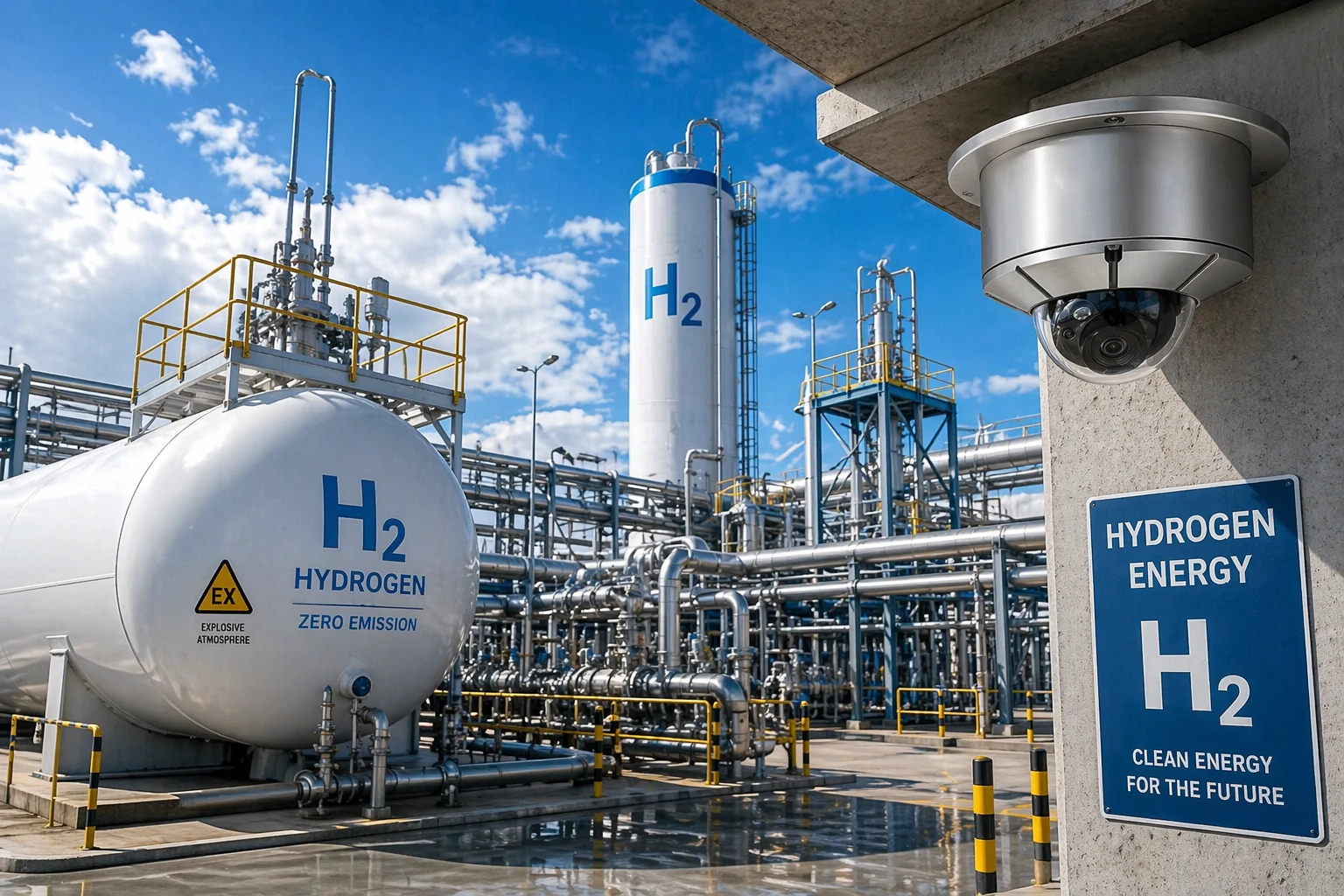
What makes an explosion-proof CCTV system different?
An explosion-proof CCTV system is more than a group of specially protected cameras. It is an integrated installation in which the camera, enclosure, cable entry, junction box, flexible tube, power supply, network connection, recorder and mounting structure must work together in the intended environment.
Oil and gas facilities may include drilling areas, wellheads, tank farms, pump stations, loading zones, pipe racks, control-room approaches and perimeter roads. Each area has a different monitoring purpose, distance and installation constraint. A successful design therefore starts with the facility layout and operational risks rather than with a product catalogue.
Step 1: Divide the facility into monitoring zones
Start by creating a camera-zone plan. Mark each area that needs continuous observation, event verification or remote inspection.
| Facility area | Monitoring objective | Typical system requirement |
|---|---|---|
| Wellhead or drilling area | Observe equipment, access and operating activity | Fixed view plus remote inspection where needed |
| Tank farm | Monitor valves, pipes, access roads and perimeter movement | Long-range coverage, PTZ inspection and night capability |
| Pump station | Watch equipment status and unauthorized access | Fixed camera with a stable view of critical points |
| Loading and transfer area | Record vehicle movement and loading operations | Directional coverage, identification detail and recording |
| Pipe rack or process area | Observe key equipment and maintenance activity | Elevated mounting, suitable field of view and reliable connection |
| Perimeter road | Monitor vehicles and approach routes | Long-distance view, low-light performance and event review |
This zone plan helps the engineering team avoid two common problems: leaving blind areas between cameras and installing too many cameras where one coordinated view would be more practical.
Step 2: Define what each camera must prove
A surveillance system should be designed around operational questions. For every camera position, define what the operator must be able to see and verify.
Examples include:
- Is a vehicle entering a restricted area?
- Can an operator inspect a valve or connection from the control room?
- Is a person approaching a pump station?
- Can recorded video show the sequence before and after an alarm?
- Is the camera view still usable at night, in rain or in dust?
- Can maintenance teams review the scene without entering the monitored area?
This step determines the required view, mounting height, recording schedule, image detail and alarm workflow. It also prevents resolution from becoming the only design criterion.
Step 3: Build the camera and accessory layer
The camera layer may combine fixed cameras, PTZ cameras, thermal cameras and specialized units. SWGJ CAMERA lists explosion-proof infrared PTZ cameras, fixed-lens cameras, dome cameras, bullet cameras and dual-sensor thermal cameras for industrial applications.
A complete installation may also require:
- Explosion-proof junction boxes
- Flameproof flexible tubes
- Cable glands and protected cable entries
- Camera brackets and support structures
- Surge protection and grounding components
- Local power or network enclosures
The accessories are not optional decoration. A suitable camera can still create an installation problem if the cable entry, junction arrangement or mounting structure is not appropriate for the same environment.
See SWGJ CAMERA’s Certified Junction Box and Flameproof Flexible Tube pages when developing the cable-protection plan.
Step 4: Plan the network architecture
An industrial CCTV system must deliver video reliably from the field to the control room, recorder or video-management platform. Network planning should consider both normal operation and a temporary fault in one connection path.
Review the following items:
- Ethernet, fiber or mixed network topology
- Distance between cameras and network switches
- Bandwidth for main and secondary streams
- Segmentation between security video and other facility traffic
- Network redundancy requirements
- Remote access permissions
- Time synchronization across devices
- Alarm and event data transmission
- Protection of exposed network equipment
For large facilities, a structured topology is easier to expand and troubleshoot than a collection of isolated point-to-point connections. The final design should be reviewed by the site’s network and electrical teams.
Step 5: Separate monitoring, recording and response
A CCTV system has three different jobs:
- Monitoring: showing current conditions to operators.
- Recording: preserving video for investigation and compliance.
- Response: connecting video events to alarms, dispatch or maintenance action.
These functions should be planned separately. A control room may need a continuous overview, while investigators need fast playback and operators may need a close-up view during an incident.
Define the following before installation:
- Which cameras record continuously
- Which cameras record on motion or alarm
- Required retention period
- Resolution and frame rate for critical views
- Number of simultaneous users
- Backup or export procedure
- Access permissions and audit records
- Procedure for reviewing an incident
A high-quality camera cannot compensate for an unclear recording and response process.
Step 6: Design for night operation and weather
Oil and gas facilities operate around the clock, often with glare, reflective metal, dust, rain and changing illumination. Night testing should be performed from the real installation position rather than only in a showroom.
Check:
- Whether the target remains identifiable after dark
- Reflections from tanks, pipes and wet surfaces
- Backlight from vehicles or work lights
- Focus stability when illumination changes
- Image contrast in shadowed areas
- Visibility through dust, haze or light rain
- Whether infrared or thermal imaging is required
SWGJ CAMERA’s product range includes infrared PTZ and dual-sensor thermal options. The exact model’s night, thermal and alarm functions should be confirmed in the project datasheet before specification.
Step 7: Make installation and maintenance part of the design
A hazardous-area camera system should be serviceable without creating unnecessary exposure for maintenance teams. Plan access, cable routing, cleaning, inspection and replacement before finalizing the mounting positions.
A practical maintenance plan should define:
- How the camera can be reached safely
- How lenses and protective windows are cleaned
- How cable entries are inspected
- How brackets and bolts are checked
- How firmware and passwords are managed
- How video exports are tested
- How spare units and accessories are stored
- Who verifies certificates after replacement
A camera position that provides a perfect view but is difficult to inspect may create higher long-term cost and downtime.
What should be included in the project handover?
Before the system is accepted, request a complete technical package:
- Final camera layout and coverage map
- Camera and accessory model list
- Exact certificates and datasheets
- Network and power diagrams
- Cable-entry and junction-box details
- Recording and retention settings
- User and permission list
- Test results for day and night views
- Alarm and event-response procedure
- Maintenance and replacement instructions
This documentation helps the owner operate the system consistently and makes future expansion easier.
How SWGJ CAMERA can support an industrial CCTV project
SWGJ CAMERA presents a product range covering explosion-proof PTZ, dome, bullet and thermal cameras, as well as explosion-proof accessories. Its website also provides industry pages for Oil & Gas Exploration, Oil Refining and Petrochemical Industry.
For a project enquiry, the engineering team should provide the site layout, hazardous-area classification, target distances, lighting conditions, network plan and required recording period. These details allow the final configuration to be checked against the actual installation rather than selected from a generic camera list.
Explosion-proof CCTV system design checklist
- Facility layout and monitoring zones are documented
- Each camera has a defined operational purpose
- Hazardous-area classification is confirmed
- Camera and accessory certificates match the installation
- Cable entries, junction boxes and flexible tubes are included
- Network topology and bandwidth are calculated
- Power, grounding and surge protection are planned
- Day and night image tests are specified
- Recording, retention and export procedures are defined
- Maintenance access and replacement procedures are documented
- Final datasheets and certificates are included in handover documents
FAQ
Is an explosion-proof camera system only about the camera housing?
No. The camera, certificate, cable entry, junction box, flexible tube, bracket, power arrangement and network connection all form part of the installation system.
Should every oil and gas camera be a PTZ camera?
No. PTZ cameras are useful for wide-area inspection and remote zoom, while fixed cameras provide continuous coverage of defined points. A practical facility may use both types, along with thermal cameras where the project requires them.
Why is the site layout important before choosing cameras?
The layout determines viewing distance, blind areas, mounting height, cable routes, network distance and maintenance access. Without it, a camera may have suitable specifications but still fail to cover the required operational area.
Do explosion-proof accessories need to be specified with the camera?
Yes. Junction boxes, flexible tubes, cable entries and brackets should be compatible with the environment and the complete installation. They should be reviewed at the same time as the camera.
What information should I send to SWGJ CAMERA for a project quotation?
Provide the site layout, monitored areas, hazardous-area classification, target distances, lighting conditions, preferred network and power arrangement, recording requirements and any required certificate or local compliance standard.
Suggested SWGJ CAMERA internal links
- SWGJ CAMERA Homepage
- Explosion-Proof Infrared PTZ Camera
- Explosion-Proof Dual-Sensor Thermal Camera
- Explosion-Proof Fixed Dome Camera
- Explosion-Proof Fixed-Lens Camera
- Certified Junction Box
- Flameproof Flexible Tube
- Oil & Gas Exploration Solutions
- Oil Refining Solutions
- Petrochemical Industry Solutions