


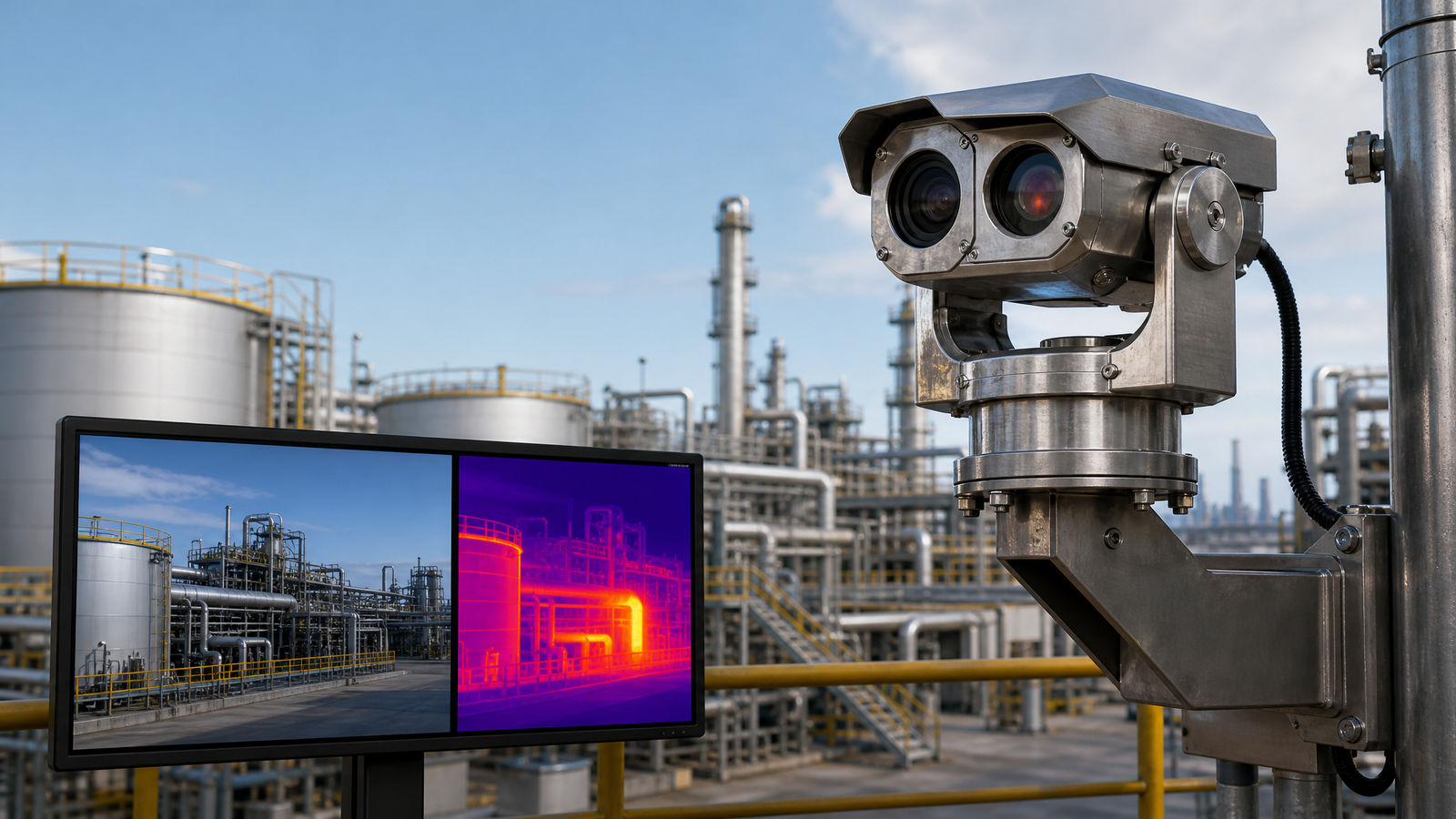
What is an explosion-proof dual-spectrum thermal camera?
An explosion-proof dual-spectrum thermal camera is a hazardous-area surveillance device with two complementary imaging functions:
- Visible-light imaging shows familiar scene detail such as equipment shape, personnel movement, valves, vehicles and access points.
- Thermal imaging shows differences in infrared radiation and apparent temperature patterns that may not be visible in a conventional image.
- Explosion-proof construction is intended to prevent the equipment from becoming an ignition source when the product is certified and installed within its approved conditions.
- PTZ movement, when included, allows the operator to inspect multiple directions or presets from a remote location.
SWGJ CAMERA presents its Explosion Proof Dual Sensor Thermal Camera as a visible-light and thermal solution for volatile industrial environments. The page describes a stainless-steel housing, dual-sensor fusion, temperature alarm and fire-detection functions, 360° pan and ±90° tilt, and applications such as refining, oil extraction, gas extraction, chemical processing, fireworks production, grain storage and gas stations.
Those public product-page statements describe the product direction. The exact temperature measurement range, accuracy, alarm algorithm, spectral response, certification scope and environmental limits must be confirmed in the final datasheet and certificate for the selected model.
Why combine visible and thermal images?
A visible camera and a thermal camera answer different questions. Visible light helps the operator understand what an object is and what is happening around it. Thermal imaging helps reveal heat distribution or abnormal thermal contrast.
| Monitoring need | Visible channel | Thermal channel |
|---|---|---|
| Identify equipment or a person | Strong visual context | Limited shape detail compared with visible light |
| Observe in low light or darkness | Depends on illumination and sensor sensitivity | Can show thermal contrast without visible light |
| Review a hot bearing, motor or electrical cabinet | May show the equipment but not the heat pattern clearly | Can highlight abnormal thermal patterns |
| Confirm smoke, glare or partial obstruction | May be affected by lighting or haze | May offer a different view, but still depends on conditions |
| Explain an alarm to an operator | Shows the surrounding scene | Shows the thermal reason for investigation |
| Verify color, signage or fine visual detail | Useful | Not the primary function |
Dual-spectrum operation is valuable because it links detection with interpretation. A thermal change can prompt the operator to inspect the visible channel, while the visible image helps confirm the asset, location and surrounding conditions.
Which hazards can thermal monitoring help you observe?
Thermal monitoring can support early investigation of heat-related conditions such as:
- Abnormal heating around motors, bearings and rotating equipment
- Uneven temperature across electrical cabinets or connections
- Hot spots on process equipment or piping insulation
- Overheated vehicles or mobile equipment
- Early signs of a localized fire or smoldering material
- Temperature changes around storage, transfer or production areas
- Thermal differences that require an operator or maintenance team to inspect
The camera should be used as one layer of a broader safety system. Thermal imaging may identify a heat pattern, but it does not by itself prove the cause. Reflections, emissivity, distance, weather, steam, smoke, viewing angle and calibration can affect interpretation. A thermal alarm should therefore lead to a defined verification and response process.
Where can an explosion-proof thermal camera be used?
SWGJ CAMERA’s public applications include oil and gas exploration, oil refining, petrochemical, chemical, grain processing and storage, coal mining and other industrial environments. Potential monitoring tasks include:
Oil and gas exploration
A thermal PTZ can help operators inspect wellhead areas, equipment zones, transfer points and other locations from a remote position. The visible channel provides context for the thermal view, while PTZ presets can organize repeated inspection routes.
Refineries and petrochemical plants
Process equipment, pumps, motors, electrical cabinets and pipe networks may require continuous observation. The camera should be installed only after the project team confirms the hazardous-area classification, mounting location, power method, network route and certificate requirements.
Chemical production
Chemical facilities can contain flammable gases, vapors, combustible dust or corrosive agents. Housing material, ingress protection, temperature rating and accessory compatibility should be reviewed together, not selected independently.
Grain handling and storage
Combustible dust creates a different risk profile from flammable gas. Equipment selection should follow the site’s dust classification and the certified protection method. Thermal monitoring may support hot-spot observation, but it does not replace dust-control, fire-protection or process-safety measures.
Coal mining
Underground and surface mining environments may require specialized products and approvals. SWGJ CAMERA lists a separate coal-mine safety product series; a general industrial thermal PTZ should not be substituted for a mining-certified model without formal confirmation.
How do you choose between a thermal PTZ and a fixed thermal camera?
| Requirement | Explosion-proof thermal PTZ | Fixed thermal or fixed explosion-proof camera |
|---|---|---|
| Large-area inspection | Useful for multiple presets and patrol views | Better for a defined continuous view |
| Continuous coverage of one asset | May move away from the asset | Keeps the asset in view at all times |
| Remote investigation | Pan, tilt and zoom support operator inspection | Provides a stable reference image |
| System design | Requires preset, patrol and operator rules | Requires careful field-of-view and mounting planning |
| Maintenance | Moving parts and positioning functions require checks | Generally simpler mechanical maintenance |
| Best practice | Combine with fixed views for critical points | Combine with PTZ for wider inspection and verification |
SWGJ CAMERA’s Explosion-Proof Infrared PTZ Camera page describes a PTZ design with continuous horizontal rotation, ±90° vertical movement, infrared lighting, optical zoom and operation in extreme temperatures. Its public parameter table includes an example configuration with 360° continuous rotation, ±90° vertical movement and a stated working temperature range. These values must be checked against the exact model selected for a project.
A PTZ camera can cover a broad area, but it cannot observe every direction at the same time. For a critical valve, loading point, electrical cabinet or access gate, a fixed camera may be needed alongside the PTZ.
How should you select visible-light and thermal specifications?
Do not select a dual-spectrum camera based only on the visible-light megapixel number. Review the complete imaging task:
- Visible-light resolution and frame rate
- Thermal resolution and sensitivity
- Thermal measurement or screening capability
- Lens and field of view for both channels
- Optical zoom and digital zoom behavior
- Focus method and minimum target size
- Detection distance and identification distance
- Day/night performance
- Image fusion, picture-in-picture or dual-stream output
- Temperature alarm zones and thresholds
- Event recording and export
- Thermal calibration and maintenance requirements
The SWGJ CAMERA dual-sensor page publicly lists a 4MP visible sensor, optical zoom, IR night vision, 304 stainless-steel housing, IP67 protection and a stated working temperature range for the displayed product information. These are product-page values, not universal specifications for every SWGJ thermal model. Confirm whether the selected model supports radiometric measurement, temperature rules, spot measurement, area measurement or only thermal imaging before describing it as a measurement instrument.
How should temperature alarms be configured?
A temperature alarm should be designed around the asset and the operating process. A single universal threshold is rarely suitable for every object.
The project team should define:
- The asset or zone being monitored.
- The normal operating temperature pattern.
- The threshold for warning.
- The threshold for urgent investigation.
- The duration or rate-of-rise condition.
- The operator or system receiving the event.
- The visible-light verification view.
- The maintenance or emergency response.
- The record that must be preserved.
Possible rules include:
- Temperature above a defined limit
- Temperature below a defined limit where cold conditions indicate a fault
- Difference between two areas or similar assets
- Rapid temperature rise over a defined time
- Hot-spot movement or growth
- Thermal change combined with motion or process state
The threshold should be approved by the process, maintenance or safety team. The camera supplier can provide technical parameters, but the operating limit belongs to the facility’s engineering and safety assessment.
Does thermal imaging detect gas leaks?
A standard thermal camera should not automatically be described as a gas-leak detector. Some specialized optical gas imaging systems can visualize certain gases under defined conditions, while ordinary thermal imaging cameras primarily show infrared radiation and temperature-related patterns.
SWGJ CAMERA’s oil-and-gas application page uses strong language about thermal signatures and leak detection. For a publishable project claim, the buyer should request confirmation of:
- The gas species the system can detect, if any
- The optical gas imaging method
- Detection distance and minimum detectable leak rate
- Environmental limitations such as wind, background and humidity
- Required calibration and testing
- Applicable certification and operating conditions
- Whether the function is a certified safety instrument or only a surveillance aid
Until those details are documented for the specific model, describe the capability as thermal anomaly monitoring or thermal-assisted inspection, not as a guaranteed gas-detection function.
What explosion-proof certification information should you verify?
Certification must be matched to the equipment, model, protection method, gas or dust group, temperature class, equipment protection level and intended zone.
Before approval, request:
- Complete certificate number
- Exact model and variant covered by the certificate
- Explosion-protection marking
- Gas and/or dust group
- Temperature class or maximum surface temperature
- Equipment protection level
- Ambient temperature range
- Cable-entry and gland requirements
- Power supply limitations
- Approved accessories and mounting arrangements
- Certificate issue and revision information
- Installation and maintenance instructions
The ATEX Directive 2014/34/EU covers equipment and protective systems intended for use in potentially explosive atmospheres. OSHA’s hazardous locations regulation explains that electrical equipment and wiring requirements depend on how the location is classified and on the properties of the flammable material. These sources provide regulatory context; they do not validate a particular SWGJ model.
A product page that mentions ATEX, IECEx, CE or another mark is not a substitute for reviewing the certificate. The certificate must cover the actual model and installation conditions.
How do housing materials and ingress protection affect selection?
SWGJ CAMERA’s product pages describe 304 stainless steel as a standard housing option and 316 stainless steel as an available customization on selected products. Material selection should follow the site’s corrosion conditions, cleaning chemicals, salt exposure, humidity, temperature and mechanical environment.
Ingress protection and explosion protection address different risks:
- IP rating concerns protection against solid objects and water ingress.
- Explosion protection concerns how the equipment prevents ignition or contains an internal fault in the specified hazardous atmosphere.
- Corrosion resistance concerns the material’s ability to withstand the operating environment.
- Mechanical protection concerns impact, vibration, mounting and tampering.
A high IP rating does not automatically make a camera explosion-proof. Likewise, an explosion-proof enclosure does not remove the need to verify water, dust, corrosion, vibration and temperature requirements.
Which accessories are part of the thermal camera installation?
A dual-spectrum camera is only one part of the field installation. SWGJ CAMERA provides accessory categories that include:
The junction box page lists certification markings, enclosure protection, cable-thread options, power input/output and optional communication, alarm and audio interfaces. The flexible-tube page describes cable protection, vibration damping, threaded fittings, IP68 protection and an Ex e IIC Gb marking in its public product information.
Check the complete installation path:
Camera housing → cable entry/gland → flexible tube or rigid conduit
→ certified junction box → power/network connection → safe-area equipment
The accessories must be compatible with the camera certificate, cable type, thread, temperature range, installation method and local regulations. Do not mix components solely because their individual pages use similar certification language.
How should a thermal surveillance system be connected?
A typical system can include the camera, local power, network transmission, recording and a control-room platform:
Explosion-proof thermal PTZ
        ↓
Certified cable entry and field accessories
        ↓
Industrial network / fiber / approved transmission path
        ↓
NVR or VMS recording and management platform
        ↓
Control-room operators and maintenance workflow
The hazardous-area camera should be separated from non-hazardous control equipment through an approved installation design. The final network may use copper, fiber, wireless bridge or another method, but the selected transmission path must meet distance, bandwidth, isolation, grounding and certification requirements.
The system should record both visible and thermal evidence when the investigation requires both. Configure synchronized timestamps, event bookmarks and export procedures so that operators can compare the thermal event with the visible scene.
How can operators reduce false thermal alarms?
False alarms can arise from reflected sunlight, hot exhaust, steam, changing weather, reflective metal, moving backgrounds, temporary maintenance work and incorrect emissivity assumptions.
Improve alarm quality by:
- Defining zones around known assets rather than large undifferentiated areas
- Setting thresholds from normal operating data
- Using a rate-of-rise rule where appropriate
- Separating warning and urgent alarm levels
- Adding schedules for known process changes
- Linking thermal alarms to visible-light verification
- Training operators to interpret thermal patterns
- Recording the reason for alarm closure
- Reviewing false alarms and adjusting the rule under engineering control
Do not disable an alarm simply because it is inconvenient. Identify the physical cause, adjust the monitoring zone or threshold through the approved process, and document the change.
What should a hazardous-area thermal camera project include?
A project specification should contain more than a product name.
| Specification section | Information to define |
|---|---|
| Hazardous-area classification | Zone, gas/dust group, temperature class and local requirements |
| Monitoring objective | Early warning, equipment inspection, perimeter, process observation or verification |
| Camera type | Thermal PTZ, fixed thermal, dual-spectrum or visible-light companion camera |
| Detection target | Asset, area, process, vehicle, personnel or potential hot spot |
| Thermal function | Imaging, screening, radiometric measurement or approved specialized detection |
| Visible channel | Resolution, lens, zoom, night mode and identification distance |
| Mounting | Height, bracket, vibration, access and field of view |
| Accessories | Junction box, flexible tube, cable glands, conduit and grounding |
| Network | Copper/fiber/wireless path, bandwidth, distance and isolation |
| Recording | NVR/VMS, retention, synchronized streams and export |
| Alarm workflow | Threshold, recipient, verification and response |
| Documentation | Datasheet, certificate, drawings, manuals and test records |
This structure helps procurement teams compare products without treating a marketing phrase as a complete engineering specification.
How should the system be commissioned?
Commissioning should test the camera as part of the installed system.
Documentation checks
- Confirm the exact model and certificate.
- Confirm the certificate covers the installed accessories.
- Check the installation drawing and cable-entry schedule.
- Record the power, network and grounding arrangement.
- Record the thermal configuration and alarm thresholds.
Visual and thermal checks
- Verify the visible-light field of view.
- Verify the thermal field of view and focus.
- Compare a known reference condition where appropriate.
- Check day, night, rain, glare and normal process conditions.
- Confirm PTZ presets, patrol routes and return positions.
Alarm and recording checks
- Trigger a controlled thermal test or approved simulation.
- Confirm alarm delivery and operator acknowledgment.
- Verify synchronized visible and thermal recordings.
- Export a test clip and confirm playback.
- Record alarm response time and test result.
Maintenance checks
- Inspect the housing, cable entries, glands and flexible tube.
- Check lens windows and cleaning procedures.
- Review temperature and alarm logs.
- Confirm firmware and configuration backup procedures.
- Define periodic inspection and recalibration requirements.
Frequently asked questions
What is the main benefit of an explosion-proof dual-spectrum thermal camera?
It combines visible-light scene detail with thermal imaging in a certified hazardous-area camera platform. The visible channel helps operators understand the scene, while thermal imaging can highlight heat patterns that deserve investigation.
Is a thermal camera the same as a fire-and-gas detector?
No. A thermal camera can support thermal anomaly monitoring and early investigation, but it should not be treated as a replacement for a certified fire-and-gas detection system or a gas detector unless the exact product is specifically designed, tested and approved for that function.
Should I choose a thermal PTZ or a fixed thermal camera?
Choose a thermal PTZ when remote inspection across multiple directions is important. Choose a fixed thermal camera when one asset or zone requires continuous observation. Critical areas often benefit from using both.
Can an explosion-proof thermal camera detect gas leaks?
Do not assume that it can. Gas detection depends on the gas species, optical method, detection threshold, environment and certification. Request model-specific evidence before making a gas-detection claim.
Is IP67 or IP68 enough for a hazardous area?
No. IP protection addresses water and dust ingress. Hazardous-area suitability requires the correct explosion-protection certification and installation conditions in addition to the required ingress protection.
Is 304 stainless steel suitable for every industrial site?
Not necessarily. 304 stainless steel is listed as a standard material on several SWGJ pages, while 316 stainless steel is offered as an option on selected products. Material selection should follow the site’s chemicals, salt exposure, humidity, temperature and corrosion risk.
What documents should be requested before purchase?
Request the exact datasheet, certificate, model list, installation manual, accessory compatibility information, power requirements, network specifications, alarm functions and maintenance instructions. Match the documents to the final quotation and installed configuration.
Final checklist
Before approving an explosion-proof dual-spectrum thermal camera system, confirm:
- The area classification is documented.
- The exact camera model is identified.
- The certificate covers the model and intended installation.
- Thermal imaging and temperature-alarm functions are clearly defined.
- Any gas-detection claim has model-specific evidence.
- Visible and thermal lenses meet the monitoring objective.
- PTZ presets and fixed views cover critical assets.
- Junction boxes, flexible tubes, glands and brackets are compatible.
- Power, network, grounding and isolation requirements are approved.
- Visible and thermal streams are recorded with synchronized time.
- Operators have an alarm verification and response procedure.
- Commissioning includes controlled tests and evidence export.
- Maintenance, inspection and recalibration responsibilities are assigned.