


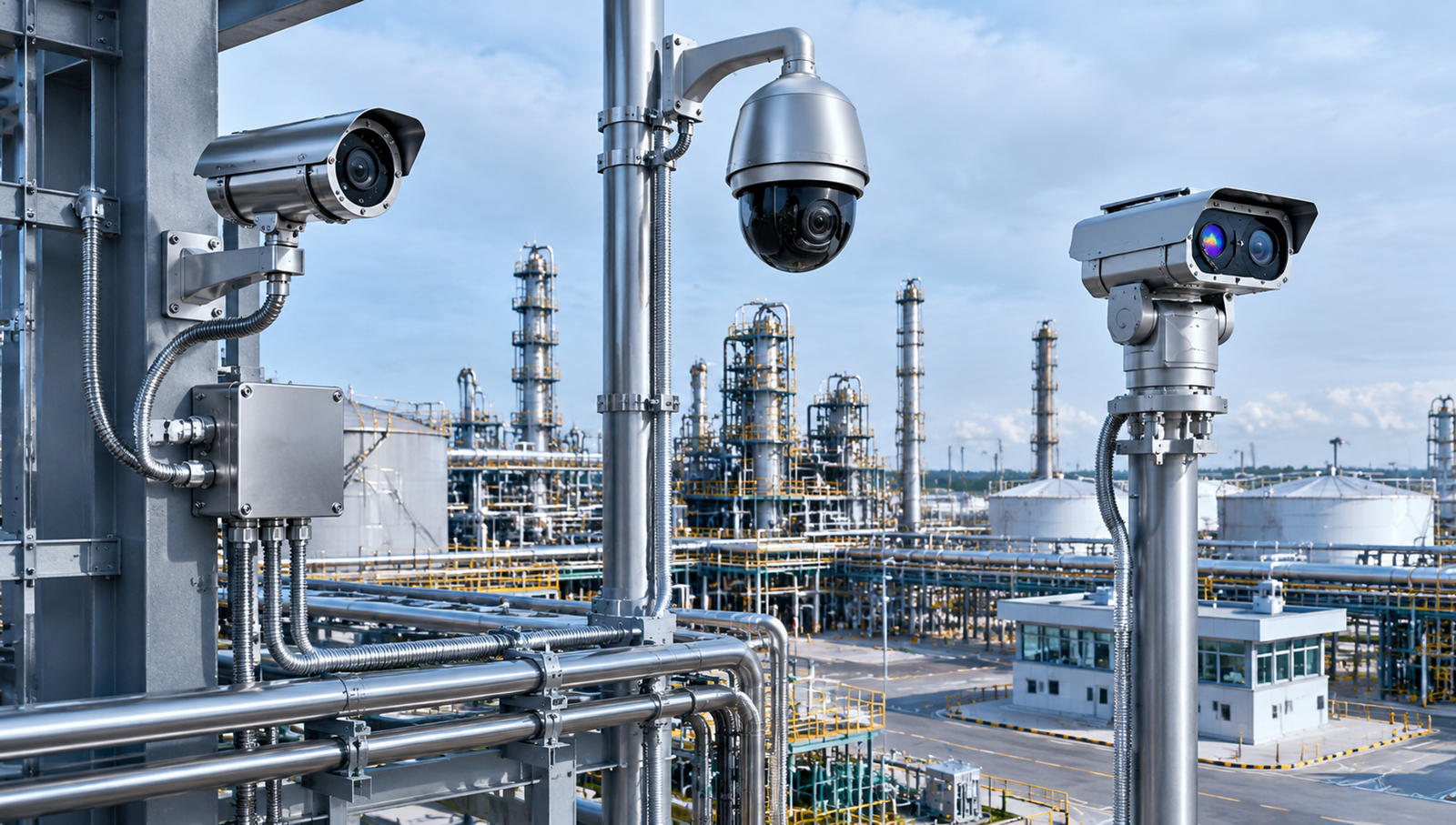
Why are explosion-proof camera accessories important?
An explosion-proof CCTV system is not complete when the camera housing has been selected. The camera must be connected, mounted and protected as part of a complete installation. Cable entries, conduit, junction boxes, brackets, power connections and network interfaces all influence whether the finished system remains suitable for its intended environment.
This is why a hazardous-area CCTV project should be evaluated as an installation system rather than as a list of camera specifications. A camera may have the required imaging performance, but an unsuitable cable entry, unprotected cable route or incompatible junction box can create a weak point in the installation.
SWGJ CAMERA’s product range includes explosion-proof PTZ cameras, dual-sensor thermal cameras, fixed dome cameras, fixed-lens bullet cameras and dedicated explosion-proof accessories. These categories can be combined according to the facility layout, monitoring objective and installation conditions.
What does an explosion-proof camera installation include?
A typical installation may contain the following elements:
- Camera: A fixed, dome, bullet, PTZ or thermal camera selected for the monitoring task.
- Mounting bracket: A mechanically suitable bracket that supports the camera and maintains the required viewing direction.
- Junction box or control box: A protected enclosure for cable routing, power distribution, network connections or other approved interfaces.
- Flexible tube or conduit: A protected route between rigid conduit, the junction box and the camera housing where vibration or movement must be accommodated.
- Cable glands and threaded entries: Interfaces that match the enclosure, cable type and project requirements.
- Power and network equipment: The approved power supply, Ethernet or fiber connection, surge protection and transmission equipment required by the design.
- Grounding and mechanical supports: The bonding, support structure and fixing hardware required by the installation method.
The final combination depends on the product certificate, site classification, environmental exposure, cable construction and local engineering requirements. Do not treat an accessory as universally compatible with every explosion-proof camera.
How does an explosion-proof junction box support CCTV wiring?
A junction box provides a protected point for organizing and connecting cables near the camera or within the wider surveillance network. In a large facility, it can simplify the transition between incoming power or network cables and the short connection route to the camera.
A suitable junction box may help the installation team manage:
- Cable entry and exit points
- Power distribution or approved power conversion
- Network connections
- Alarm or auxiliary interfaces, when supported by the selected equipment
- Cable separation and routing inside the enclosure
- Maintenance access under an approved procedure
SWGJ CAMERA’s Certified Junction Box page describes a protected box for hazardous environments involving explosive gases or dust. The page lists stainless-steel construction options, multiple cable-thread configurations and optional communication, alarm and audio interfaces. These details show why the junction box should be selected from the actual wiring plan rather than added as an afterthought.
Before ordering, confirm the following points:
- The enclosure’s certification scope matches the project classification.
- The cable entry thread matches the selected gland or conduit fitting.
- The available internal space is sufficient for the planned terminals and connections.
- The power, network, alarm and audio interfaces match the system architecture.
- The enclosure protection level is appropriate for water, dust, washdown and corrosion exposure.
- The mounting position allows inspection and maintenance without compromising the installation.
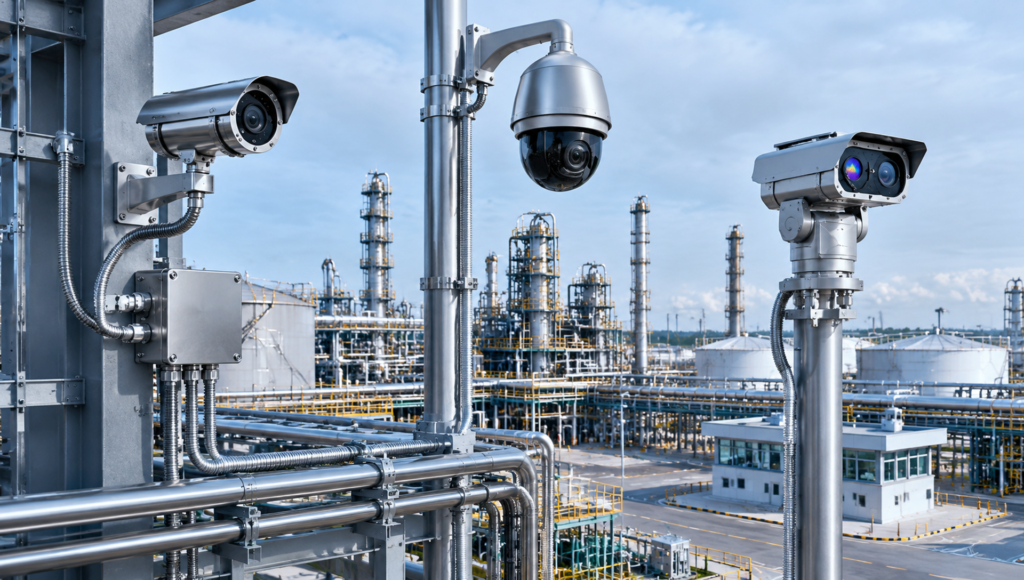
Figure 2. A close view of a camera housing, protected junction box, flexible tube and mounting bracket. Place this image after the junction-box section.
Why is a flameproof flexible tube used near the camera?
A flexible tube is useful where the cable route must bridge a short gap between rigid conduit, a junction box, a bracket or a camera housing. It can accommodate practical installation movement and help protect cables from abrasion, vibration and mechanical stress.
SWGJ CAMERA’s Flameproof Flexible Tube page describes the accessory as a protected cable route for hazardous-area wiring. The page lists connector and length options and describes use in environments where cables connect between rigid routes and explosion-proof equipment.
The flexible section should be treated as part of the protected cable-entry design. It should not be selected only because it looks robust. The installer should verify:
- Connection thread and fitting compatibility
- Length and bend radius for the planned route
- Material suitability for moisture, chemicals, salt spray and temperature
- Protection and certification requirements
- Mechanical support so the tube does not carry unintended camera weight
- Cable fill, pulling method and strain relief
- Sealing and tightening procedures specified by the manufacturer
A flexible tube must also be routed carefully. Avoid sharp bends, excessive tension, unsupported loops and contact with hot surfaces or moving equipment. The final installation should maintain a clean, inspectable path from the camera housing to the protected connection point.
What role does an explosion-proof camera bracket play?
A bracket determines how the camera is physically fixed and aimed. It also transfers the camera’s weight and environmental loads to the supporting structure. In outdoor oil, gas, chemical or marine applications, wind, vibration, corrosion and maintenance access should be considered together.
A suitable bracket should provide:
- Stable support for the exact camera size and weight
- A mounting pattern compatible with the camera and structure
- Adequate clearance for the housing, lens movement and cable entry
- A protected route for the flexible tube or conduit
- Sufficient adjustment for the required field of view
- Corrosion resistance appropriate to the installation environment
- A practical maintenance position for inspection and cleaning
For a PTZ camera, the bracket must also support the camera’s movement envelope. A fixed bullet or dome camera may need a different mounting arrangement because the lens direction, housing clearance and service access are different.
The Explosion-proof Infrared PTZ Camera page describes a camera intended for wide-area industrial monitoring and remote inspection. The fixed-lens bullet camera page describes a fixed-view product category for defined monitoring zones. These different camera roles should be reflected in the bracket and cable-routing design.
How should accessories be matched to the camera type?
The camera type should be selected first according to the operational question, then the installation accessories should be matched to the camera and site.
| Camera type | Typical monitoring role | Accessory planning focus |
|---|---|---|
| Fixed-lens bullet camera | A defined view of pumps, valves, access points or equipment | Stable bracket, fixed field of view, protected cable entry |
| Fixed dome camera | Compact monitoring in confined spaces or corridors | Low-profile mounting, clearance around the dome, protected route |
| Infrared PTZ camera | Long-range inspection across tank farms, pipe racks or process areas | Strong bracket, movement clearance, flexible connection and maintenance access |
| Dual-sensor thermal camera | Visible-light confirmation plus thermal observation of abnormal heat | Stable mount, protected data/power route and clear thermal field of view |
| Mining or specialized industrial camera | Monitoring in specialized high-risk environments | Exact product certification, site-specific mounting and approved accessories |
This table is a planning aid. The actual accessory list must be checked against the exact model documentation and project requirements.
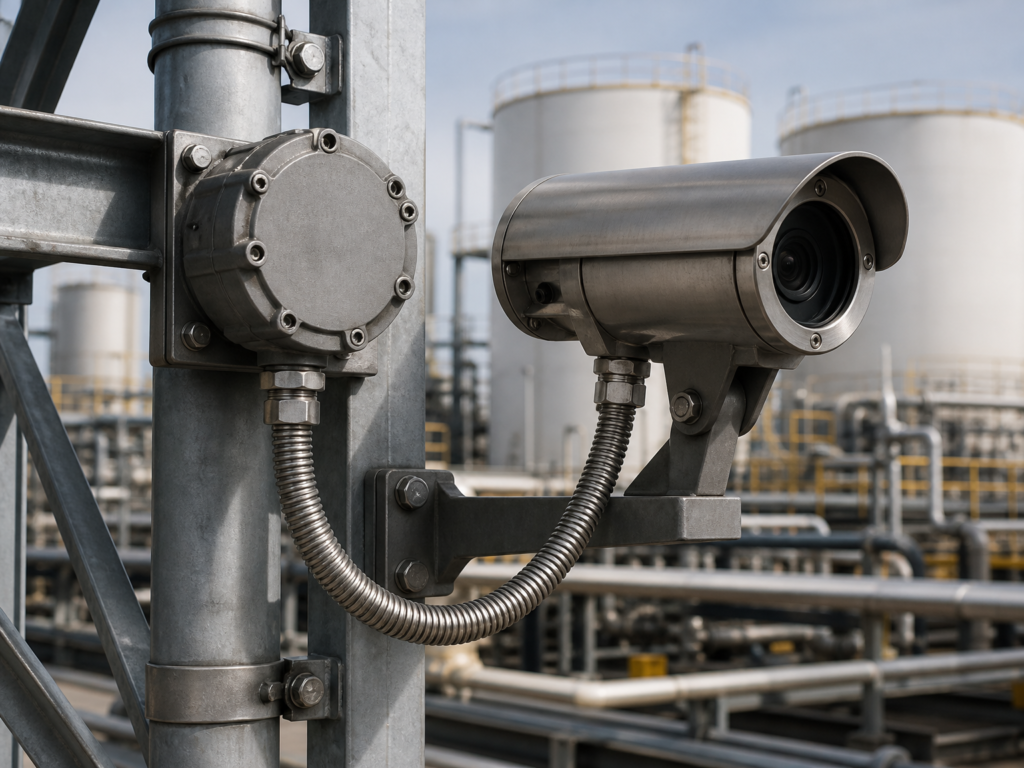
Figure 3. Infrared PTZ and thermal cameras supporting long-range industrial monitoring. Place this image after the camera-type matching table.
How do you plan explosion-proof camera wiring?
Begin with a route drawing rather than installing the camera first. Mark the camera position, junction box, rigid conduit, flexible tube, cable entries, network equipment, power source and maintenance access.
A practical planning sequence is:
- Define the monitoring objective. Decide whether the camera must show a fixed point, cover a wide area, inspect a distant asset or identify abnormal heat.
- Confirm the hazardous-area requirements. Record the zone, gas or dust group, temperature class, ambient temperature and corrosion conditions for the installation point.
- Select the camera category. Choose fixed, dome, bullet, PTZ or thermal imaging according to the required field of view and operating task.
- Map the cable route. Minimize unnecessary bends and keep the route accessible for inspection.
- Select the junction box and flexible tube. Match threads, fittings, materials, protection and certification scope.
- Check the bracket and structure. Confirm load, vibration, wind exposure, camera movement and clearance.
- Review power and data compatibility. Confirm voltage, network interface, transmission distance, grounding and surge protection.
- Prepare an inspection checklist. Record tightening, sealing, cable identification, grounding, live view, recording and alarm tests.
This sequence helps prevent a common installation problem: choosing the camera first and discovering later that the selected cable route or accessory cannot be used at the mounting location.
What should be checked before commissioning?
Before handing over the system, the installation team should verify both safety-related requirements and surveillance performance. The checklist should include:
- Camera model and certificate match the approved equipment list.
- Junction box, flexible tube, glands and brackets match the installation documentation.
- Cable entries are correctly fitted, sealed and supported.
- The camera is mechanically stable and does not place unsupported load on the flexible tube.
- Grounding and bonding have been completed according to the project design.
- The camera provides the intended field of view in daylight and at night.
- PTZ movement, presets, focus and zoom have been tested where applicable.
- Thermal imaging views and alarm thresholds have been reviewed by the responsible team.
- Network communication, time synchronization and recording are operating correctly.
- Maintenance access and equipment identification are documented.
Certification markings and protection ratings should be checked against the exact product documentation. They should not be copied from a different model or treated as interchangeable across a product family.
How can SWGJ CAMERA support a complete installation?
SWGJ CAMERA’s website presents a product range covering explosion-proof PTZ cameras, fixed dome and bullet cameras, dual-sensor thermal cameras, coal-mine safety products, thermal-imaging industrial cameras and explosion-proof accessories. The accessory pages for junction boxes and flexible tubes are particularly relevant when a project needs more than a camera body alone.
For a project inquiry, prepare the site classification, application area, required field of view, camera distance, power and network conditions, cable-route sketch, ambient temperature, corrosion exposure and required installation accessories. This information allows the technical team to assess the complete surveillance arrangement instead of recommending a camera without the supporting installation details.
Frequently asked questions
Are explosion-proof camera accessories optional?
Not always. Their necessity depends on the camera design, cable route, hazardous-area classification, installation method and project documentation. A complete system may require a certified junction box, flexible tube, cable glands, bracket and other approved components.
Can any junction box be used with an explosion-proof camera?
No. The junction box must match the hazardous-area requirements, cable entries, environmental conditions, internal wiring plan and certification scope. Confirm compatibility with the exact camera and project documentation.
Why not connect the camera with an ordinary flexible cable tube?
An ordinary tube may not provide the protection, sealing, mechanical strength or certification required for the application. The cable route should be selected as part of the approved hazardous-area installation.
Does a flexible tube support the camera’s weight?
It should not be assumed to do so. The bracket and structural support should carry the camera load. The flexible tube should provide a protected cable route and accommodate the required connection movement.
Should PTZ and fixed cameras use the same bracket?
Not necessarily. PTZ cameras may require more structural support, movement clearance and service access. Fixed bullet or dome cameras have different mounting geometry and viewing requirements.
Does an IP rating alone make a camera suitable for a hazardous area?
No. IP protection addresses dust and water ingress under defined test conditions. Hazardous-area suitability also depends on the product’s protection method, certification scope, classification and installation requirements.
What information should be included in an accessory inquiry?
Include the camera type or model, hazardous-area classification, environment, mounting position, cable type, cable-entry thread, required flexible length, power and network interfaces, bracket arrangement and any special temperature or corrosion conditions.