


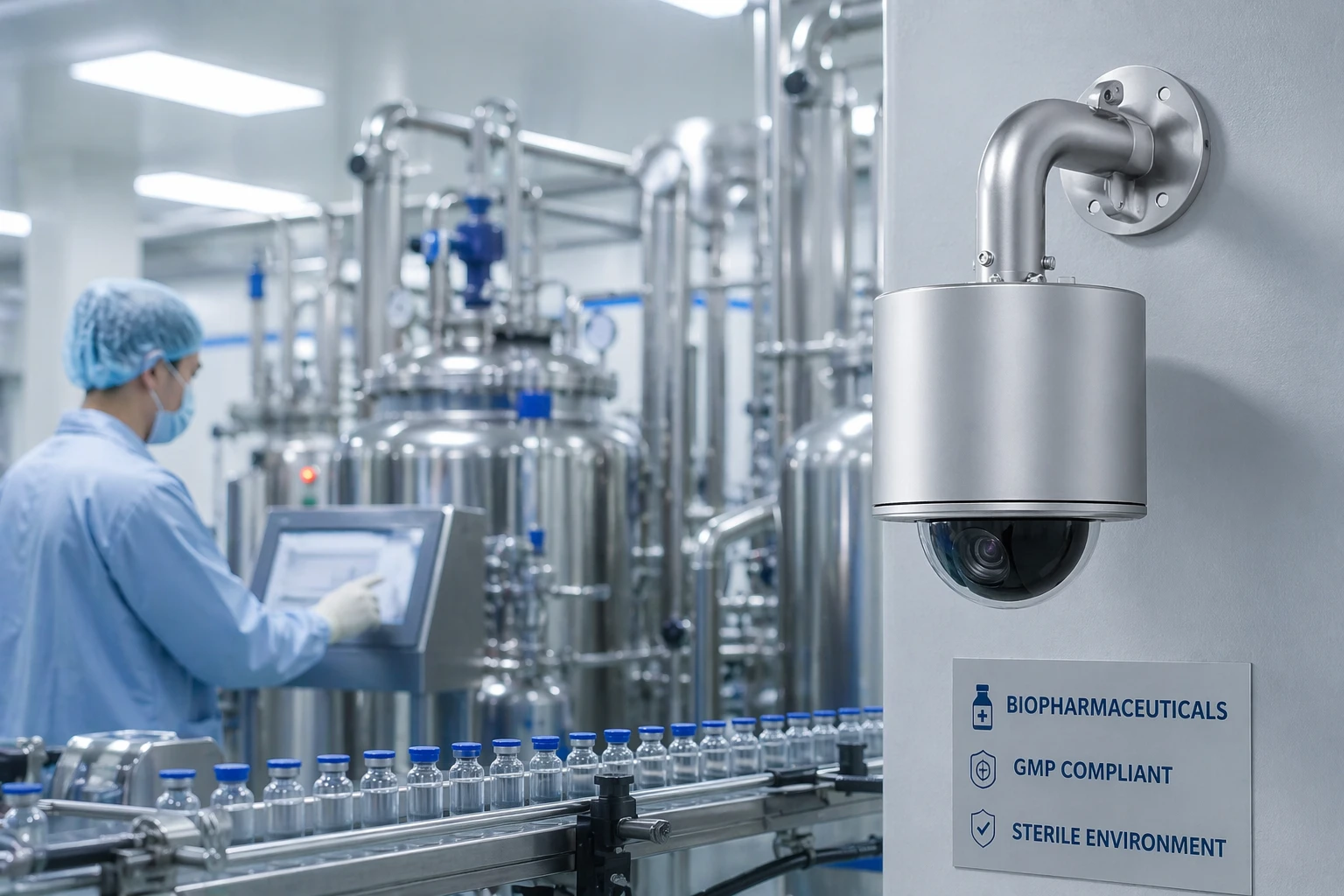
What Is an Explosion-Proof Camera?
An explosion-proof camera is a surveillance device engineered for a defined hazardous area where flammable gases, vapors, liquids or combustible dust may be present. Its purpose is not simply to withstand a harsh environment. The camera and its installation must be designed so that normal operation, electrical faults or an internal ignition source do not create an unacceptable risk outside the protected enclosure.
A safe system depends on more than the camera body. The equipment classification, protection technique, housing, viewing window, cable entries, power supply, network connection, mounting accessories and installation method must all match the project requirements.
SWGJ develops explosion-proof surveillance solutions for industrial applications including petrochemical facilities, oil and gas sites, coal mines, chemical plants, marine projects, power facilities and other environments requiring long-range or high-definition monitoring. Its product portfolio includes explosion-proof PTZ cameras, fixed dome cameras, bullet cameras, dual-sensor thermal cameras and related accessories.
Important safety note: A general product description or IP rating does not prove suitability for every hazardous location. The exact model marking, certificate scope, temperature class, gas or dust group and installation requirements must be checked before procurement.
Why Is Hazardous-Area Classification the First Step?
Before selecting an explosion-proof camera, the project team should identify the hazardous-area classification and the substances that may be present. OSHA explains that hazardous locations are classified according to the properties of flammable vapors, liquids or gases, combustible dusts or fibers, and the likelihood that a hazardous concentration will be present. Each room, section or area should be considered individually.
Depending on the country and project specification, documentation may use Class and Division, Zone, or another local classification system. These designations should not be treated as interchangeable without engineering review.
A camera selection brief should include:
- The type of hazardous material: gas, vapor, liquid, dust or fiber
- The applicable Class, Division, Zone or local designation
- The gas or dust group
- The required temperature classification
- The minimum and maximum ambient temperature
- The required protection technique
- The installation location and mounting height
- Cable-entry, conduit and grounding requirements
- The approval documents required by the local authority or project owner
OSHA also states that equipment must be approved not only for the class of location but also for the ignitable or combustible properties of the specific gas, vapor, dust or fiber present. This is why buyers should request model-level technical documentation rather than relying on a general category label.
How Does an Explosion-Proof Camera Prevent Ignition?
1. It uses a robust enclosure
The enclosure separates the internal electrical and optical components from the surrounding hazardous atmosphere. SWGJ product pages describe 304 stainless steel as the standard housing material for several explosion-proof camera configurations, with 316 stainless steel available for selected applications requiring greater corrosion resistance.
Stainless steel can be useful in industrial environments exposed to moisture, salt spray, cleaning agents or corrosive chemicals. The correct material, however, should be selected according to the site environment and the specific product documentation.
2. It controls the path of an internal ignition event
A flameproof or explosion-proof enclosure is designed to prevent an internal ignition event from igniting the surrounding atmosphere when the equipment is used within its approved conditions. The enclosure, joints, fasteners, cable entries and related components form part of the protection concept.
This means that field modifications are not a cosmetic issue. Drilling the housing, using an unapproved cable gland or replacing an approved component with an incompatible part can compromise the protection system.
3. It protects the viewing window and optical path
Explosion-proof cameras use a protective viewing window designed to maintain optical performance while providing mechanical protection. The window material, thickness, sealing method and mounting structure must be evaluated with the certified product assembly.
The window also affects image quality. Poor installation angle, condensation, dust or chemical deposits can reduce identification detail even when the camera electronics are operating normally.
4. It manages cable entries and accessories
A camera should not be evaluated separately from its cable entry and installation accessories. SWGJ’s product range includes explosion-proof flexible tubes, junction boxes and camera brackets intended to support complete hazardous-area installations.
The cable gland, conduit, junction box, power input, network connection and grounding method should be selected according to the camera certificate and local installation rules. The accessory must not be treated as a generic replacement part unless its suitability has been confirmed.
5. It matches operating temperature requirements
Temperature classification is a core part of hazardous-area equipment selection. A camera may operate in a wide ambient range, but the certified temperature class and maximum surface temperature must still be appropriate for the substances present at the site.
For example, SWGJ publishes an operating range of approximately -40°C to +60°C for its HB-8000S explosion-proof infrared PTZ camera page. Other models have different published ranges. Buyers should use the exact model documentation rather than applying one camera’s specification to the entire product family.
What Are the Main Explosion-Proof Camera Types?
| Camera type | Typical monitoring role | When it is a good fit |
|---|---|---|
| Explosion-proof PTZ camera | Wide-area inspection, long-distance observation and operator-controlled views | Large yards, storage areas, loading zones, pipelines and perimeter monitoring |
| Fixed explosion-proof dome camera | Fixed-area monitoring with a compact form factor | Confined spaces, corridors, cabins, entrances and indoor industrial areas |
| Explosion-proof bullet camera | Directional monitoring of a defined target | Gates, pipe racks, fences, process points and long corridors |
| Dual-sensor thermal PTZ camera | Visible-light detail plus thermal detection | Fire-risk monitoring, smoke, fog, low light and equipment-temperature observation |
| Explosion-proof accessories | Connection, mounting and field installation support | Projects requiring compatible junction boxes, flexible tubes and brackets |
Explosion-proof PTZ cameras
A PTZ camera is suitable when operators need to inspect different directions from one mounting position. SWGJ’s HB-8000S product page describes continuous 360-degree horizontal rotation, ±90-degree vertical movement, infrared night vision, 2MP to 8MP resolution options and up to 50x optical zoom for the listed configuration.
PTZ selection should consider more than zoom. Review preset accuracy, pan and tilt speed, low-light performance, network bandwidth, mounting load, maintenance access and the approved environmental range.
Fixed dome cameras
A fixed dome is often appropriate where the viewing direction is known and the installation space is limited. SWGJ’s fixed mini dome page describes a compact design, 304 stainless steel housing, an optional 316 stainless steel upgrade, IP68 protection, IK10 impact resistance and fixed-lens options for the listed configuration.
These specifications are useful for project comparison, but the final decision should be based on the exact model datasheet and certificate. A compact housing does not remove the need to verify classification, installation and cable-entry requirements.
Explosion-proof bullet cameras
A bullet camera provides a directional view and can be useful for entrances, process corridors, loading points and perimeter areas. SWGJ’s published varifocal camera information describes fixed explosion-proof cameras with optional IR or white-light illumination, 304 stainless steel housing, IP68 protection, PoE or AC/DC input options and selected lens configurations.
A varifocal design can help installers adjust the field of view during commissioning. It should still be selected according to the required identification distance, lens range, lighting, mounting position and approved configuration.
Dual-sensor thermal cameras
A dual-sensor thermal PTZ combines a visible-light camera for detail identification with a thermal sensor for heat-pattern detection. SWGJ describes its dual-sensor thermal camera as a solution for applications such as pipeline monitoring, early fire-risk detection and observation in smoke, fog or darkness.
Thermal imaging does not replace visible-light evidence or a dedicated fire-protection system. It is a monitoring and detection component whose alarm logic, temperature limits and integration should be validated for the project.
What Does an IP Rating Mean?
An IP rating describes the enclosure’s resistance to ingress from solids and liquids. The IEC explains that the first numeral relates to protection against solid objects, while the second numeral relates to protection against liquids.
For example, an enclosure rated IP68 has a defined level of dust protection and water-ingress protection under specified test conditions. The exact test conditions and manufacturer documentation must be reviewed.
An IP rating is not the same as explosion-proof certification:
- IP rating: resistance to dust and water ingress
- Explosion-proof or flameproof approval: suitability for a defined hazardous location and protection concept
- Temperature classification: allowable surface-temperature relationship for the relevant hazardous atmosphere
- Installation approval: compatibility of cable entries, conduits, glands, power and mounting components
A camera can have a high IP rating and still be unsuitable for a hazardous location if the required approval is missing or does not cover the actual site conditions.
How Should an Explosion-Proof Camera Be Installed?
Installation should be handled by qualified personnel familiar with hazardous-area equipment and the applicable local requirements. The following checklist helps reduce common project errors:
- Confirm the area classification before equipment selection.
- Match the camera marking and certificate to the classified area.
- Confirm the gas or dust group and temperature classification.
- Use compatible cable glands, conduit, junction boxes and brackets.
- Follow the manufacturer’s cable-entry and grounding instructions.
- Keep enclosure joints, fasteners and seals intact.
- Do not drill, weld, repaint or modify the certified housing without written approval.
- Verify the power supply, surge protection and network design.
- Check the camera’s field of view during both day and night.
- Test live video, recording, alarms, remote access and failover before handover.
The complete installation should be inspected as a system. A camera may show a clear image while the actual installation still has problems with grounding, cable sealing, network stability or recording continuity.
How Do You Choose the Right SWGJ Camera?
Start with the monitoring task, then match the product type:
- Choose an explosion-proof PTZ camera for large areas, long viewing distances and operator-controlled inspection.
- Choose a fixed dome camera for compact installations, corridors and defined indoor or sheltered areas.
- Choose a bullet camera for directional coverage of gates, process points, fences and pipe corridors.
- Choose a dual-sensor thermal PTZ when visible detail and thermal monitoring are both required.
- Add an explosion-proof junction box, flexible tube or camera bracket when the installation design requires compatible accessories.
SWGJ’s public product structure covers oil and gas exploration, oil refining, petrochemical, fine chemical, coal mining, offshore and marine engineering, LNG/CNG stations, hazardous-material storage, grain processing and other industrial applications.
For OEM or project-based procurement, provide the supplier with:
- Site classification and hazardous material information
- Required camera type and viewing distance
- Resolution, lens and night-vision requirements
- Ambient temperature and corrosion conditions
- Power, network and recording requirements
- Required certificates and marking format
- Installation accessories and cable-entry requirements
- Quantity, lead time, spare parts and after-sales expectations
Frequently Asked Questions
What is the principle of an explosion-proof camera?
The principle is to contain or control potential ignition sources through a certified enclosure, protection technique, electrical design, cable-entry system and installation method. The equipment must be approved for the specific hazardous location and operating conditions.
Are explosion-proof cameras waterproof?
Some models have an IP rating for dust and water ingress, but the exact rating must be checked in the model documentation. Waterproof or dustproof performance does not replace hazardous-area certification.
What housing material does SWGJ use?
SWGJ product pages describe 304 stainless steel as a standard housing material for several explosion-proof camera configurations. Selected pages also describe 316 stainless steel as an optional upgrade for applications requiring additional corrosion resistance.
Which camera is suitable for a large oil and gas site?
A PTZ camera may be suitable for wide-area observation and long-range inspection, while fixed bullet or dome cameras can cover defined points. The final choice depends on area classification, viewing distance, lighting, network design and the approved product configuration.
Can a thermal camera be used for fire-risk monitoring?
A dual-sensor thermal camera can help identify abnormal heat patterns and support early warning in selected applications. It should be integrated into a project-specific monitoring and alarm plan and should not be treated as a replacement for the site’s fire-protection system.
Can SWGJ provide customized explosion-proof camera solutions?
SWGJ’s public website describes OEM/ODM support and customized solutions. The permitted scope of customization must be confirmed because changes to housing, electrical configuration, cable entries or other certified components may affect the approval scope.
What documents should I request before placing an order?
Request the exact model datasheet, certificate or approval document, product marking information, installation manual, cable-entry requirements, dimensional drawing, environmental limits, warranty terms and accessory compatibility information.
Conclusion
Explosion-proof camera safety is based on a complete engineering chain: correct hazardous-area classification, certified protection, suitable enclosure construction, controlled cable entries, compatible accessories, reliable imaging and professional installation.
SWGJ provides several camera architectures for this chain, including PTZ, fixed dome, bullet and dual-sensor thermal solutions, together with explosion-proof junction boxes, flexible tubes and brackets. The right configuration should be selected from the project requirements rather than from resolution or appearance alone.
Before purchasing, share the site classification, hazardous materials, viewing objective, environmental conditions and installation plan with the supplier. Then confirm the model-level certificate and technical documents for the final configuration.
Suggested Internal Links
- Explosion-Proof PTZ Cameras
- Explosion-Proof Dome Cameras
- Explosion-Proof Bullet Cameras
- Dual-Sensor Thermal Cameras
- Explosion-Proof Camera Accessories
- Certified Junction Box
- SWGJ Official Website